There is no shortage of people taking up the game. It’s the rate at which they’re staying in the game that we need to learn from.
Every year from 2020 through 2025, more than three million Americans tried the on-course game for the first time. That’s six consecutive years the industry has eclipsed a mark it had never reached prior to the pandemic.
Approximately 2.4 million Americans played for the first time in both 1999 and 2000, when Tiger Woods was at his zenith of performance and popularity. Today’s pace has topped that Tiger-era high by nearly 30% annually… and sustained it for years longer.
So, what’s behind the surge?
The pandemic pushed Americans toward safe, outdoor activities, and golf courses — open-air, socially friendly for people of all ages, and newly compatible with remote work schedules — were well positioned to benefit. That momentum continues like waves coming on shore.
Off-course formats, from golf entertainment venues to indoor simulators, have given newcomers lower-pressure entry points, building the confidence that has led many to activate their latent demand and make the move from the couch to the course. Speaking of latent demand (non-golfers who say they’re “very interested” in playing on a golf course), it’s more than doubled since 2014, giving the industry a deep well to draw from. And the newcomers themselves are diversifying the game’s makeup: beginners are more likely to be female and People of Color than existing golfers, a pattern that’s helped drive participation gains among youth, Black, Hispanic, Asian, and female golfers since the pandemic began.
The challenge is retention and deepening the engagement among those new to the game. The golf course continues to be intimidating to novices.
Roughly one in four beginners becomes a committed golfer, a rate that hasn’t really moved even as beginner inflow hit record highs. While more than 19 million Americans have tried the game for the first time since 2020, the on-course participant base has seen a net increase of just over four million during the past six years. That means millions who try golf still walk away without becoming real customers. Many end up as “super-occasionals,” playing once every few years.
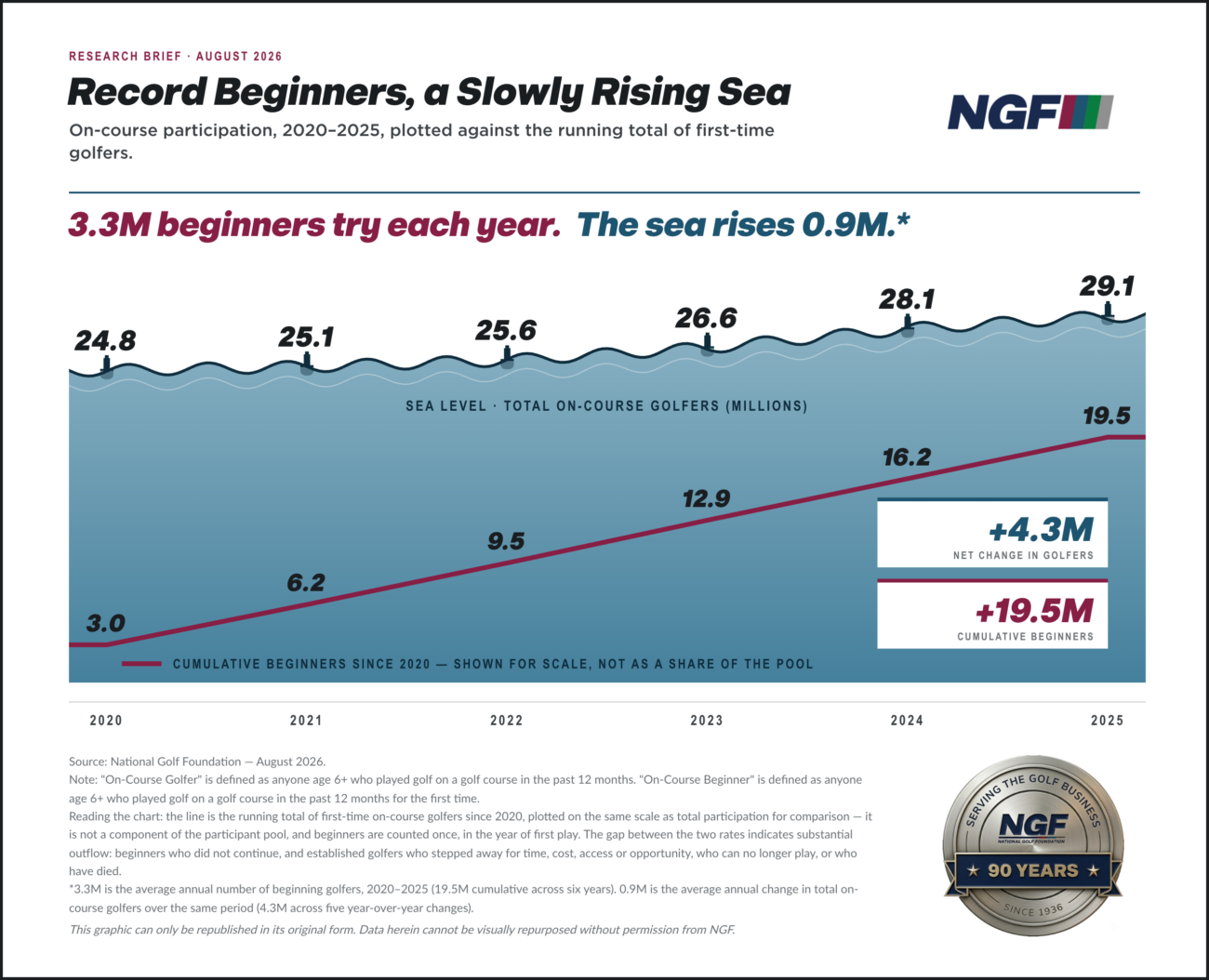
All that said, the net effect has been genuine growth rather than stagnation. Imagine the growth in participation if we improved the retention rate by even 5%.
Traditional participation now sits at its highest level since 2009 but clearly there is much room to improve. Operators need to lean into the opportunity, first by elegantly identifying the beginners who require a higher level of service… and then through hospitality that makes the golf course a more comfortable place for them.
Golf doesn’t have an attraction problem — but hooking people on golf is another matter entirely. If you want a deeper dive into what causes the millions of failed trials, please call and talk to NGF.