When PopStroke opened its first location about five years ago, in Port St. Lucie, Florida, indoor golf simulators were part of the business plan.
But owner Greg Bartoli quickly found out it made financial sense to go in a different direction, focusing instead on the brand’s core proposition — putting — and layering in a variety of backyard party games along with a robust food and beverage offering.
Today, with more than 20 locations nationwide and ambitious plans to more than double that in the next several years, Bartoli sees PopStroke as a platform that exists adjacent to, yet is still influential within, the broader ecosystem of golf.
While the concept is rooted in golf, with a growing portfolio of tech-enabled putting venues that blend golf with F&B and social experiences, this modern golf entertainment version of mini golf isn’t counted among NGF’s off-course forms of participation. But there’s no question PopStroke’s reach extends well beyond the core player and taps into a wider audience that the industry has long struggled to engage.
“We unequivocally think there’s a big role for PopStroke in the future for both the game of golf and also for introducing people to beginning golf,” he says.
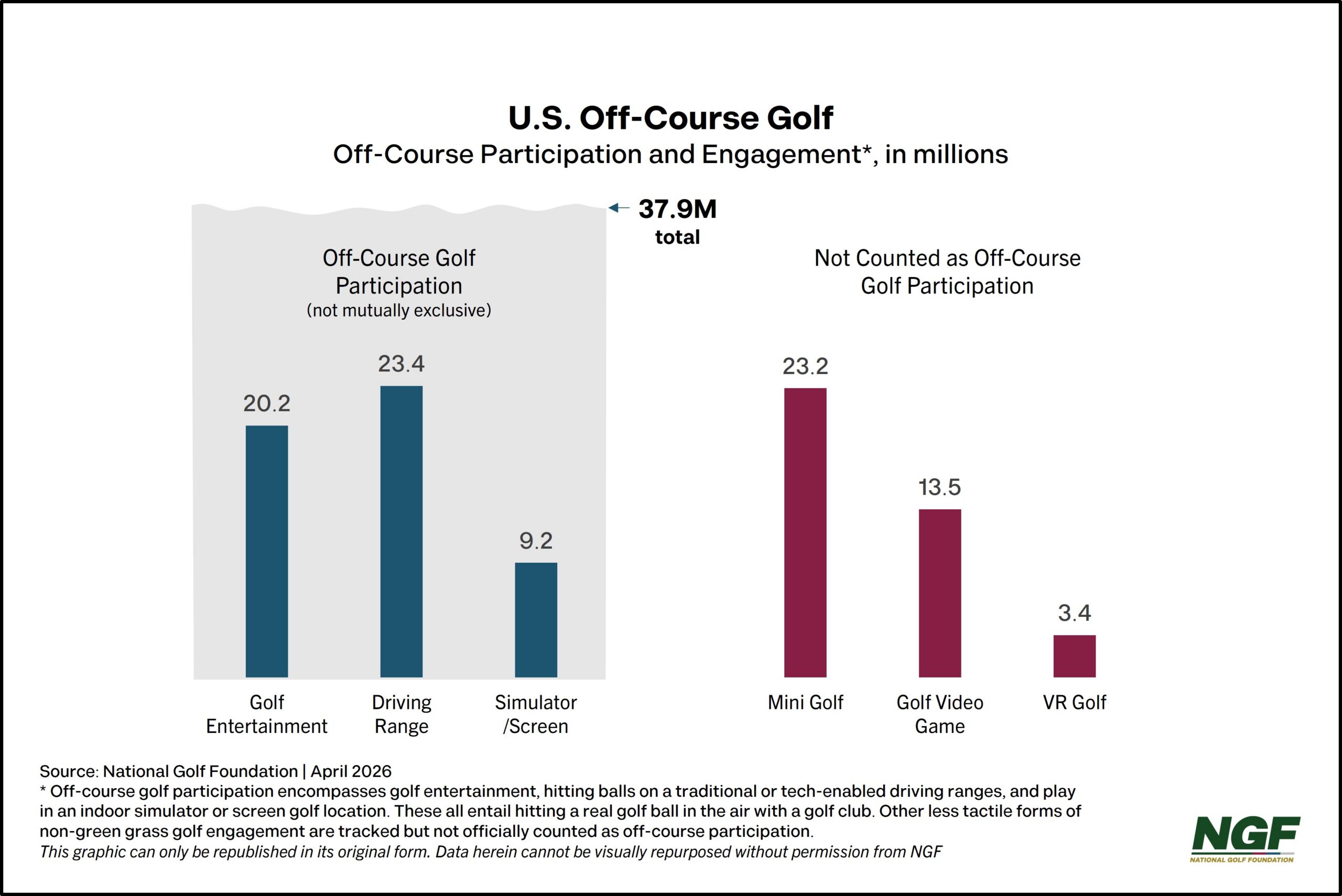
NGF’s official measures of off-course forms of participation encompass those activities in which people hit real golf balls in the air with a golf club. This includes golf entertainment venues like Topgolf as well as traditional and tech-enabled driving ranges, and indoor golf simulators and screen golf set-ups.
PopStroke doesn’t fit in that category, falling instead within the miniature golf measure despite courses are designed by experienced golf architects to mirror real golf conditions – from speed to slope, contours and break. And PopStroke has a partnership with one of the game’s biggest equipment companies, TaylorMade, for putters to use at its venues.
“Now, if you’re a beginner, you can get lucky and bang it off a mound and it happens to come back,” said Bartoli. “But if you’re a seasoned golfer and you play it the right way, you’re looking at the lines, you’re reading the breaks.
“It does have a big future in a game of golf because we’re going to have 4 million visitors this year and (still) growing as we open new stores,” he added. “But that connection point, (especially) with young children and beginners, is in a way that you don’t really feel intimidated. So, you hit a bad putt. It’s not the same as swinging and missing a 7-iron or dribbling a 7-iron three feet in front of you when a lot of people are looking.”
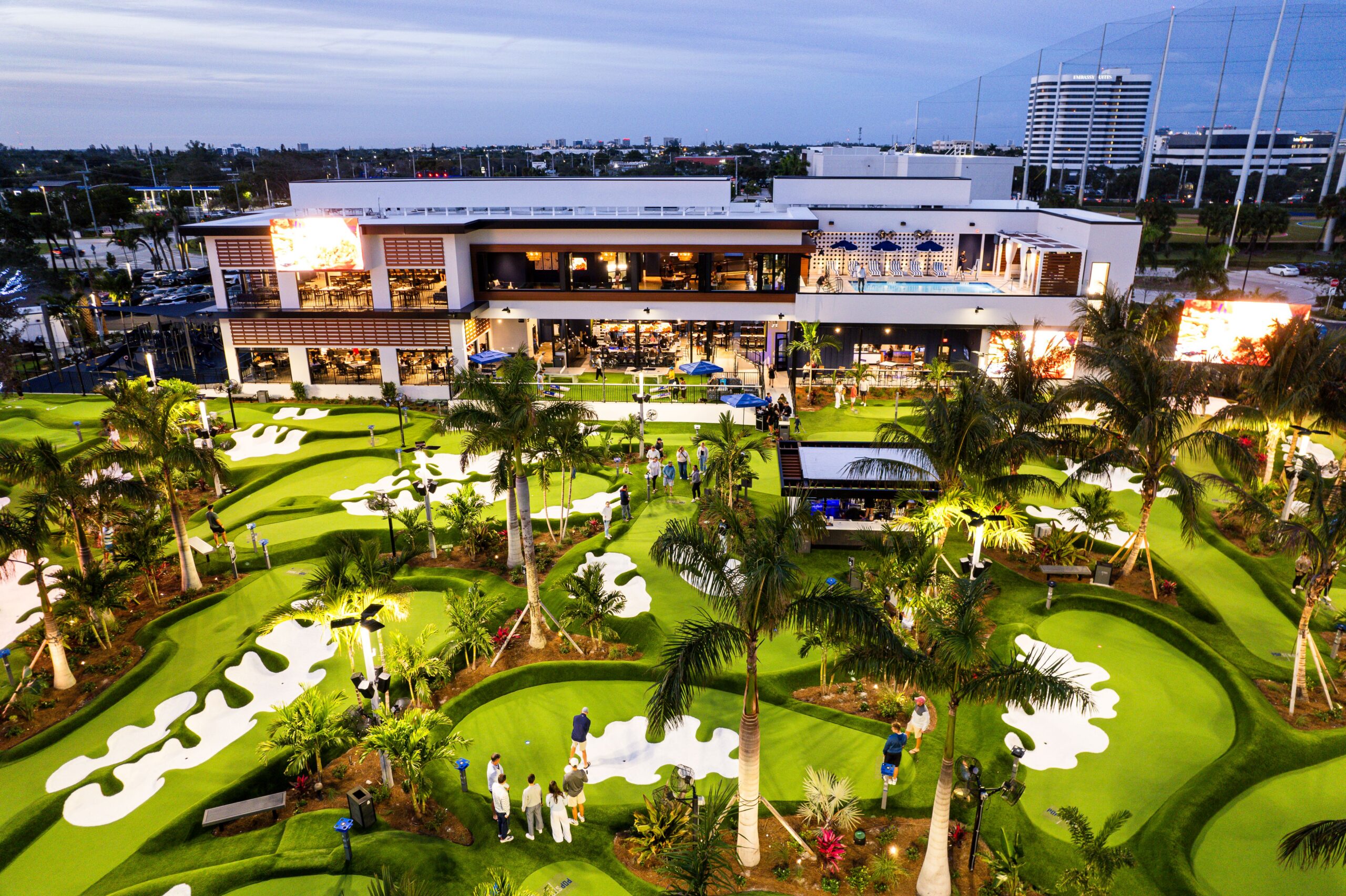
The PopStroke location in West Palm Beach, Florida.
Impact on Latent Demand?
PopStroke’s appeal starts with accessibility – for players from age 3 to 90. And unlike a driving range or a full round, putting is inherently less intimidating. That low barrier to entry is critical for converting curiosity into action — a key challenge for an industry in which only about one in four beginners ultimately becomes a committed golfer.
As detailed by this Short Game article, interest in golf among non-golfers remains historically high.
This is spurred, in part, by a shifting cultural perception of golf as more inclusive and social, as well as a recognition that the game’s future isn’t confined to 18-hole rounds on a course.
More than 21 million non-golfers say they are “very interested” in playing on a traditional course, while an even larger group — over 28 million — express strong interest in off-course forms of the game. That widening funnel, driven in part by entertainment-focused venues, represents one of golf’s clearest growth opportunities. And again, that measure of non-golfer interest doesn’t include putting-based golf entertainment like PopStroke.
“I definitely think there’s a transition, especially with younger kids from here to green-grass traditional golf,” said Bartoli, noting PopStroke’s opportunity to function as both a gateway and as a complementary experience for existing golfers.
But he’s also realistic that the majority of visitors are not future golfers.
“Seventy-five percent of our guests are just looking to rock to the music, have a bunch of cocktails and spray the putter everywhere,” he says. “Twenty-five percent I would call avid golfers.”

Players (of all ages) putt on the custom-designed courses at PopStroke.
That split underscores an even broader reality: off-course golf doesn’t need to convert everyone to be valuable. Even partial conversion — or simply deeper engagement with the game in any form — can help sustain overall growth.
As golf continues to evolve, the lines between on-course and off-course experiences are becoming increasingly blurred. Concepts like PopStroke can expand the top of the funnel, introducing new players in a less intimidating environment, while keeping existing golfers engaged in different ways.
“I love seeing seniors come here, with their Scotty Cameron or TaylorMade Spider putters, and they’re exchanging $20 bills on the 18th hole,” said Bartoli. “Just four seniors out there as a foursome and they’re betting and they’re marking the cards, and then you see them get off the 18th hole and there’s changing money like they would at your local country club.”