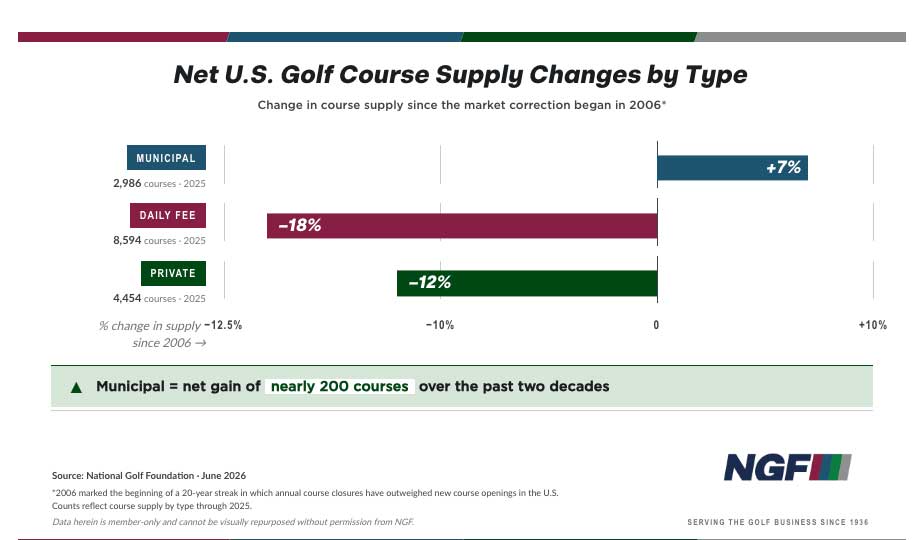
As the U.S. golf market has experienced a supply correction over the past two decades – with a net reduction of more than 2,000 golf courses – there’s quietly been a curious trend: a slow, upward climb in the municipal golf space.
Dating back to 2006, the number of municipally owned and operated golf courses has increased by 7% while the two other ownership segments (daily fee public courses and private clubs) have undergone notable contraction.
At the start of this year, there were nearly 3,000 municipal golf courses at over 2,600 facilities, the highest totals on record.
This muni momentum predates the pandemic. And it isn’t the byproduct of states, counties or cities building new courses. In fact, the last new 18-hole, regulation-length municipal golf course built in the U.S. from the ground up – and unaffiliated with a resort or entity beyond the local municipality – opened in 2023.
Conversions instead are the primary contributor, with municipalities acquiring former private or daily fee public courses. Over the past decade alone, hundreds of private and daily fee public courses have re-classified as municipal properties, with cities or counties adding them to their recreation or park programs.
The first municipal golf course opened in New York in 1895. Not long after the game arrived in the U.S., municipalities first became involved in the golf business to provide an affordable recreation amenity to residents.
Municipal golf today is serving the same purpose it did more than a century ago — providing affordable, accessible golf to local communities. The difference is that many municipalities have been (and are) expanding their golf footprints while the broader market has shrunk.
While some communities will continue to evaluate the role of golf within their broader parks and recreation systems, others are moving in the opposite direction — acquiring facilities, preserving green space, and ensuring affordable access to the game for future generations.
Municipalities still face significant challenges when it comes to golf courses, perhaps most notably aging infrastructure – from irrigation and the courses themselves to clubhouses. Almost 70% of muni facilities in the NGF database are more than 50 years old. There’s also maintenance and labor demands, capital reinvestment and rising customer expectations.
Despite challenges in some areas, municipal golf is in an unprecedented place.
During a 20-year period when overall golf course supply has contracted by almost 13%, municipal golf has quietly become one of the game’s most important stewards.
And NGF, the industry’s foremost expert on the municipal space for decades, is currently working on a comprehensive study on the municipal side of the game – from its history and benefits to its economics. We live it and we’ll continue to study it. Stay tuned.