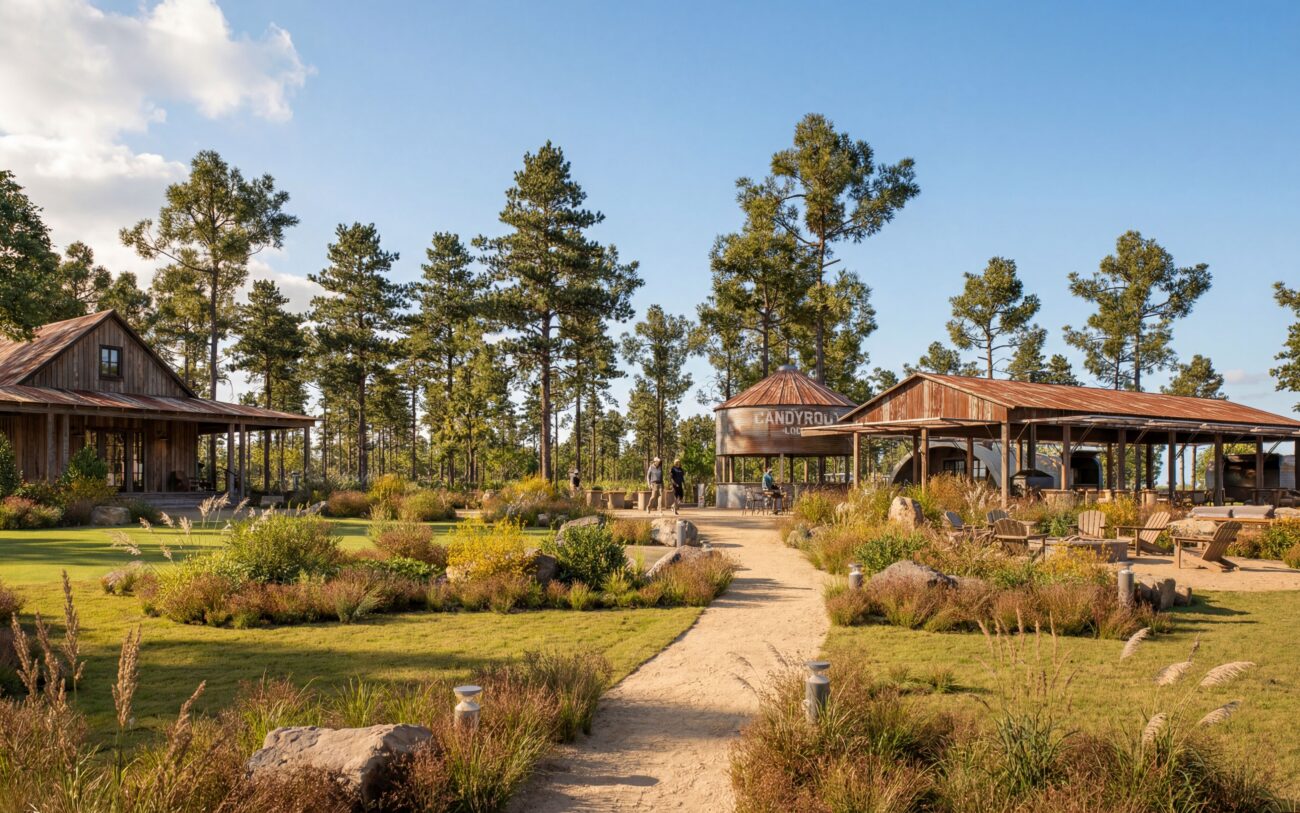
There’s a new golf resort coming to the Sandhills of South Carolina, and it’s bucking the trend in one of the most active states for new golf course development.
The planned five-course project called Candyroot is the lone public facility among the nine with new courses in the development pipeline in South Carolina, according to NGF’s Construction Report. The Palmetto State trails only Florida and Texas in terms of new courses in the works (17 at nine facilities) but has skewed almost entirely private with clubs such as Cypress Shoals, Kawonu, New Holland, Orange Hill and 21 Golf Club. And openings in recent years have included private courses such as Anson Point, Broomsedge, Old Barnwell, Old Sawmill and The Tree Farm.
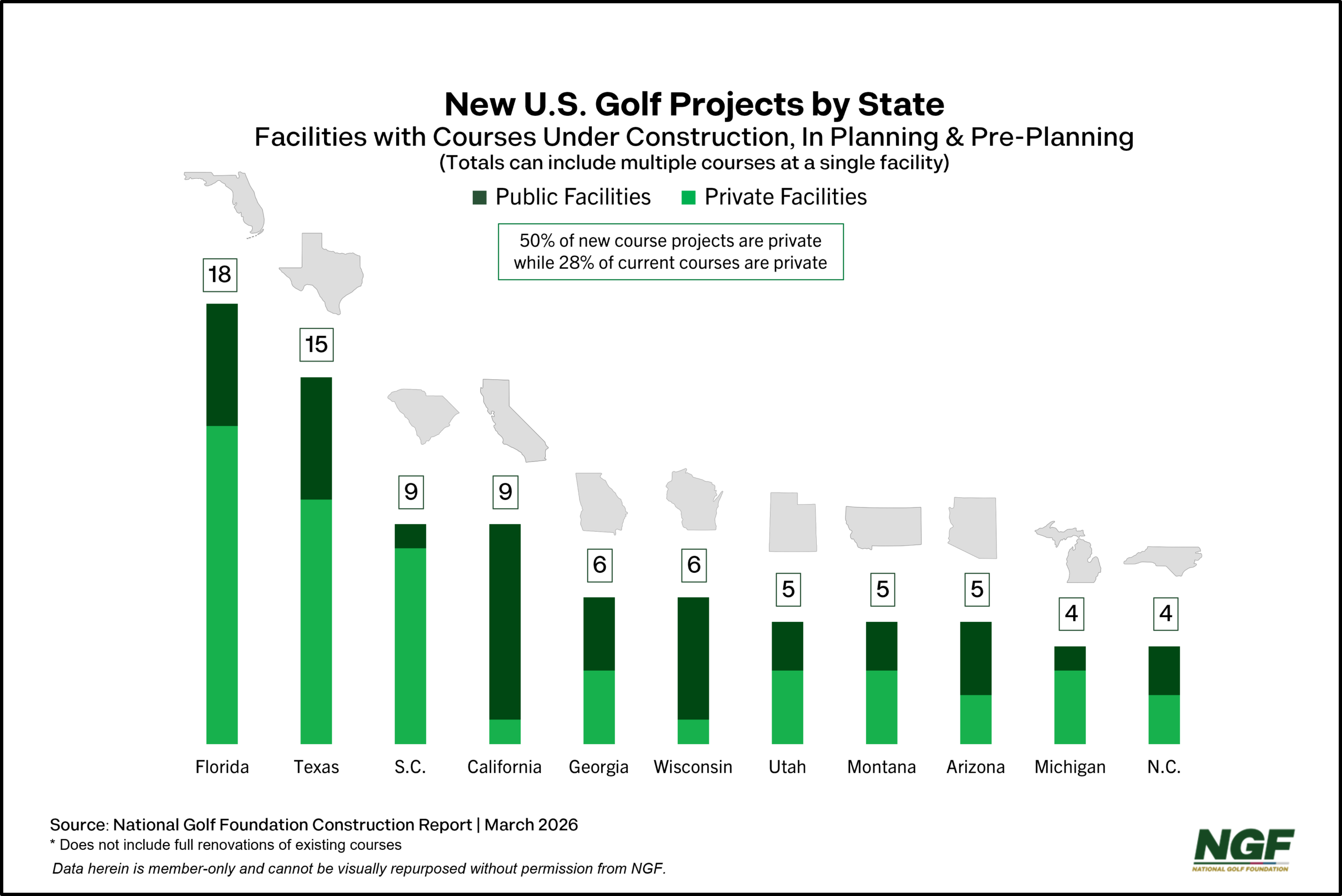
Among the top 10 states in current development — as shown in the below graphic — South Carolina has by far the highest proportion of private facilities building new courses at 89%. Just over 70% of Florida’s projects are private, as are about two-thirds of those in Texas. California is on the other side of the spectrum, with eight of the nine facilities building or planning to build new courses being public.
Candyroot’s first course, designed by architect Mike Koprowski, is scheduled to open for preview play in November, with a full public debut in spring of 2027. At that time, it will officially be added to NGF’s Facility Database, the industry’s gold standard that’s celebrating its 90th anniversary in 2026. A second 18-hole layout and a short course are in the active planning stages, with two others 18s to follow.
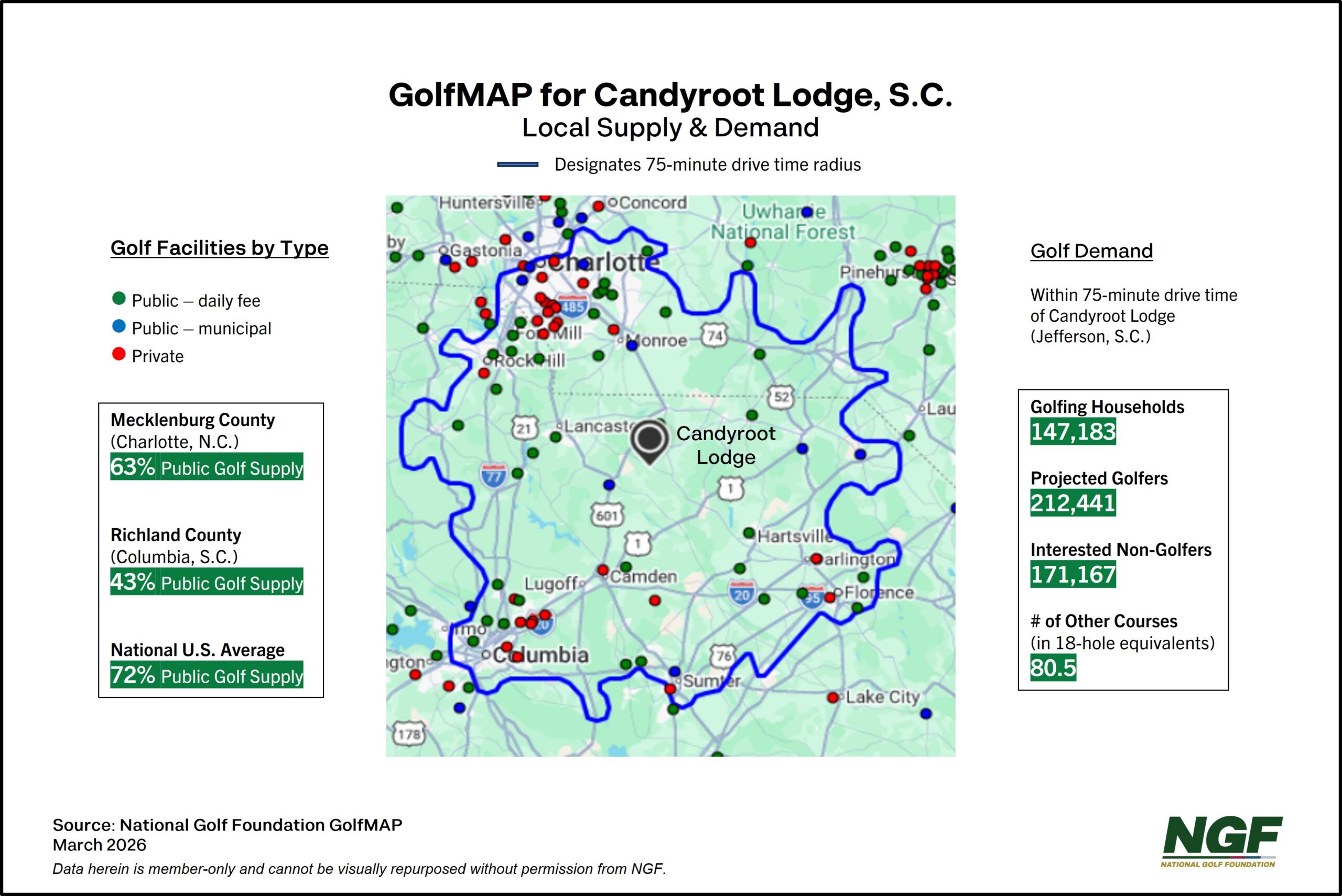
South Carolina had just over 350 courses at the start of 2026, the 17th most in the nation, according to NGF data. Two-thirds of those are public, below the national average of 72%.
The ownership behind Candyroot, which is named after a small native plant that grows in sandy soil, acquired just over 1,200 acres about an hour from both Charlotte, North Carolina, and Columbus, South Carolina, to develop the multicourse resort retreat. In addition to the publicly accessible golf – including a lighted par-3 course for nighttime play – the property will feature lodging and restorative wellness amenities, with a long-term vision that is “grounded in nature, rejuvenation and connection.”
“The Sandhills offer some of the most compelling natural golf terrain in the country, and we recognized a clear opportunity to create a publicly accessible destination inspired by the land,” said Candyroot proprietor Aaron Oberman, who was one of the first investors in Broomsedge, the private club located less than an hour south of Candyroot.
In addition to South Carolina being the fastest-growing state in the U.S. in 2025 in terms of rate of population growth, the Charlotte and Columbia markets count approximately 300,000 golfers between them, according to NGF’s GolfMAP platform. And there are another 185,000 non-golfers who say they’re “very interested” in playing golf on a course. Both markets, however, are relatively undersupplied when it comes to public golf. Nearly half the golf holes in Columbia are private, while nearly 40% in Charlotte are open only to members – significantly higher than the national average of about 28%.
The below GolfMAP report looks at a 75-mile drive time radius of Candyroot from a supply and demand standpoint, so includes sparsely populated rural areas and doesn’t extend to parts of the nearby metro areas.
NGF’s facility tracking efforts reveal that half of the new golf course projects under construction, in-planning or in pre-planning nationwide are private, but the imbalance is even more pronounced in South Carolina, which sits at the intersection of climate, golf culture and migration trends, not to mention that it has greater land availability relative to many other states.
“When I stumbled across the parcel that is now my course, course one, I thought, ‘Holy cow. This is really, really good,’” said Koprowski, whose design at Broomsedge has earned rave reviews. “And then I (told the owners), ‘You know, this is an hour from Charlotte and its sand. I don’t know that gets any better than this.’”
As for the first course, it doesn’t have a name yet beyond Candyroot.
Whether the courses at the property have their own individual identity (like Pacific Dunes, Sheep Ranch, Bandon Trails and Old Macdonald at Bandon Dunes Golf Resort in Oregon, or Mammoth Dunes, Sedge Valley, The Commons and The Lido at Sand Valley in Wisconsin), or go by some other naming convention – numbers, colors, directions – hasn’t been determined yet. But the designers for the next couple of courses should be identified shortly, with an intent to use “next-generation golf architects,” said fellow co-proprietor Ethan Oberman, Aaron’s brother.
“That was a commitment we made early on, because we wanted those guys to have a voice and there need to be courses that give those guys opportunities to do what they want to do, especially in the public sphere,” said Ethan Oberman. “Obviously, it’s nothing against the big-name architects. They’re wonderful and they’ve built great courses. But we felt strongly about giving the next generation architect a chance. Most of the ones we’re talking to are well-developed and well-known but giving that an opportunity to public sphere is something they’re really excited about.”

A rendering of the first green at Candyroot’s first course — a rare new public layout currently under construction in South Carolina.