As golf’s popularity has grown in recent years, two of its most frequently cited appeals are its social and competitive nature. For some golfers and in certain markets, however, increased participation has made securing tee times more difficult. One response to this challenge, from both golfers and course operators, has been the rise of leagues.
The number of U.S. golfers participating in leagues, whether run internally by golf facilities or externally by national organizations such as Twilight Golf and Spark Golf, has jumped 68% since 2019. Over that same post-Covid period, the correlative rise in the number of on-course golfers is 20% (24.3 million to 29.1 million).
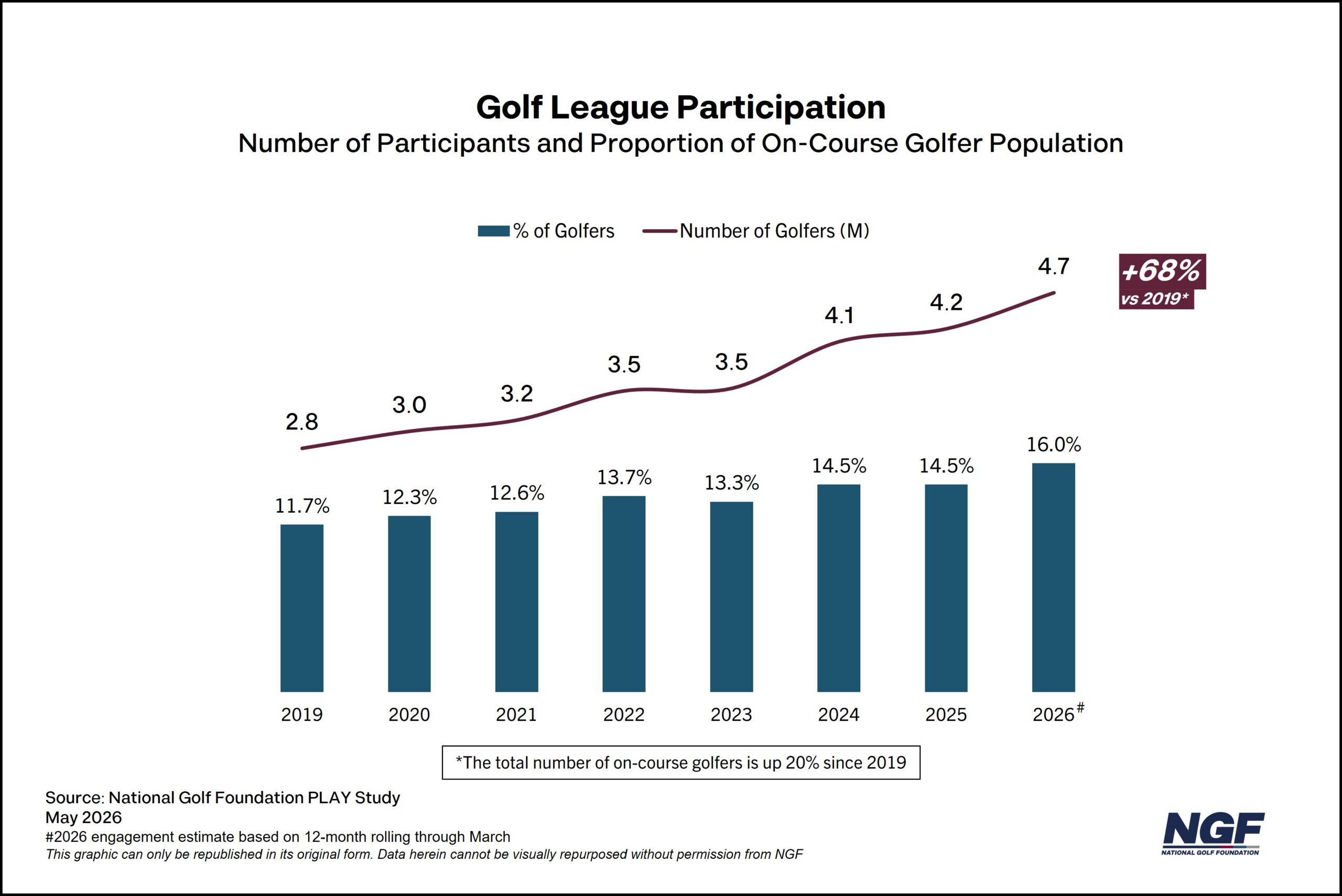
When we surveyed golfers less than a decade ago about golf leagues, there were twice as many non-participants who expressed interest in joining a league than those who were playing in leagues at the time. The primary reasoning behind their interest: they were seeking to capitalize on the social aspects of the game and the opportunity to play more frequently.
Like a lot of things in the world of golf, the game’s post-pandemic popularity has seemingly served as a catalyst, spurring more golfers to join leagues and prompting not only greater facility engagement but a wider variety of leagues in recent years.
Leagues can help address the challenge of access at a time when nearly two-thirds of public facilities report being at or near capacity (meaning how much more play they can handle before it starts to have a negative effect on business from an operational, staffing or course upkeep standpoint). Being able to reserve these blocks of times, often in evenings for 9-hole rounds, also means that leagues enable golf to be more of a priority in people’s busy schedules.
In that respect, leagues help turn a late afternoon or evening on the links into “appointment golf” — a built-in commitment that becomes part of one’s routine, planning, and overall lifestyle rather than an occasional, ad hoc activity.
Adult leagues are shown to deepen engagement, regardless of age or avidity. League participants play and spend a disproportionate amount given their size in the population, including more than twice as many annual rounds-played as non-participants. They’re also more likely to continue playing golf than those who aren’t interested in a league.
And recent league participants are more diverse than in the past, with a greater percentage of women, younger participants, and People of Color taking part. Additionally, occasional (or casual) golfers who play fewer than eight rounds a year are leaning in more heavily. More on the makeup of golf league participants, including the proportion of kids playing in programs such as PGA Jr. League, can be found in this accompanying member piece.
For operators, an important takeaway is that leagues aren’t just a programming add-on. They can strategically manage demand, build “appointment golf” into customers’ routines, and cultivate more frequent, higher-value play from a loyal audience. In a capacity-constrained environment, those who prioritize and thoughtfully structure league offerings are better positioned to convert current interest into long-term engagement and retention.