When it comes to post-pandemic participation gains in recreational golf, women and girls have outpaced their male counterparts and accounted for a greater share of growth.
Over the past six years (from 2020 to 2025), there has been a 45% rise in the number of on-course, female golfers. This participant pool has experienced a net gain of 2.5 million, climbing to more than 8.1 million in total, the highest count on record.
During that same six-year span, there’s been a corresponding 12% rise among the male golfer population – a net increase of 2.3 million players.
In total, women and girls have accounted for 52% of the net participation gains in green grass golf from 2020 to 2025. This shift has helped push female representation within the traditional golfer population to 28%, the highest proportion on record, and up from 20% in 2012.
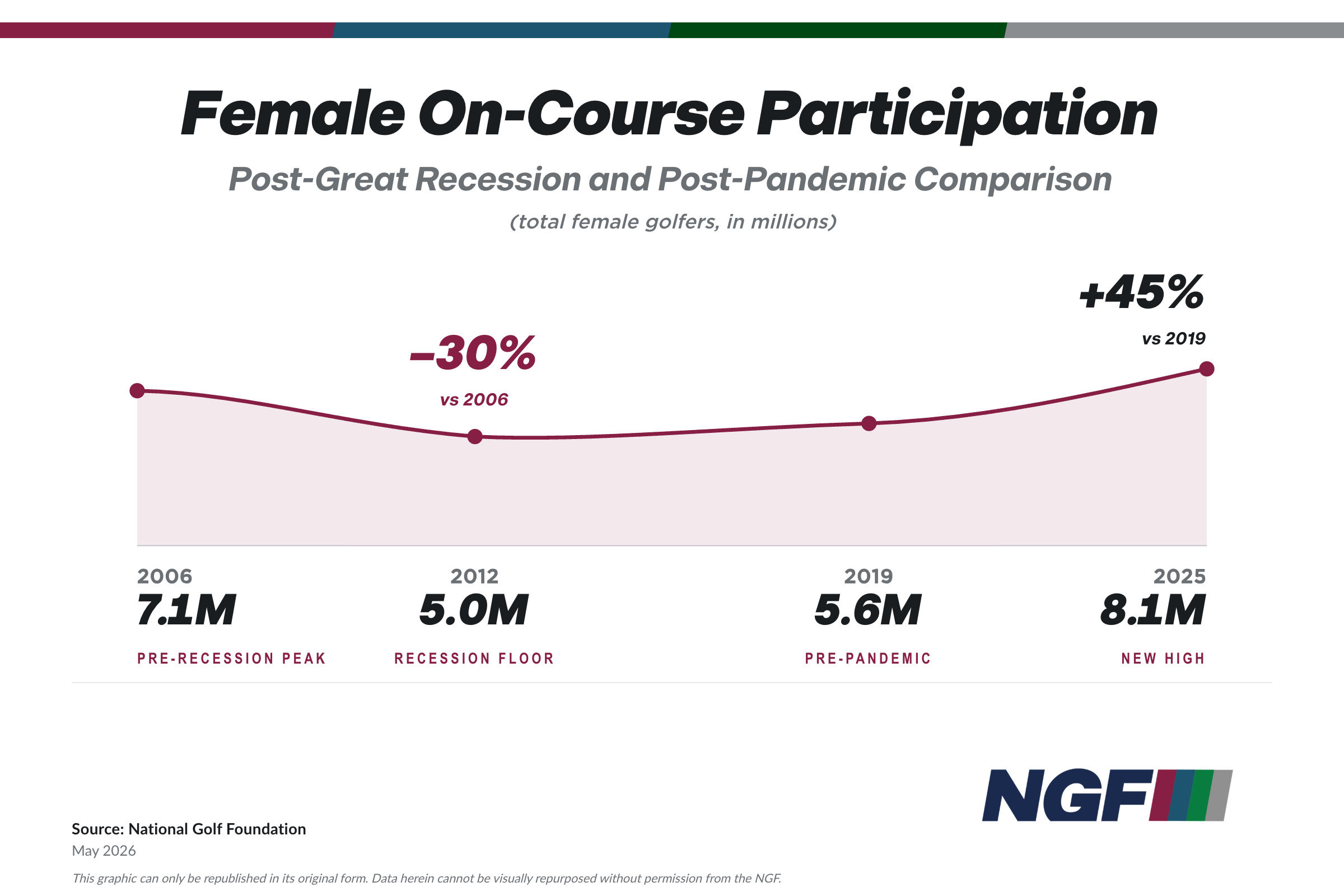
What’s particularly interesting (at least for us at the NGF), is that the momentum of recent years has more than reversed the declines seen in the female participation ranks following the Great Recession. Consider that prior to the past two years, the highest number of on-course, female golfers was 7.1 million in 2006.
The economic downturn that occurred just under two decades ago was felt acutely in many industries, particularly a discretionary pursuit like golf. And the impact from a gender perspective was especially profound.
From 2007 through 2012, the number of on-course, female golfers dropped by 30%, a net decline of 2.1 million. On the men’s side, the net decline was greater (2.6M), but the comparable proportional change was only -11%. That gap is telling.
From an economic and sociological perspective, the recession disproportionately disrupted the time and spending of women for a number of reasons. Among them, more married women entered the U.S. workforce (per the Bureau of Labor Statistics) as many households sought to compensate for lost income, and females disproportionately absorb a greater share of family responsibilities, whether household or childcare, during times of economic stress.
Female participation levels began their recovery after 2012, but the real rise in engagement was accelerated more recently by the pandemic… and by new forms of off-course helping provide greater access and lower the game’s intimidation factor.
Today, women and girls not only make up a higher proportion of new golfers, including beginners and returners, they also have greater representation among off-course only participants and among non-golfers who are interested in playing on a course.
The critical component for continued industry health is ensuring those women and girls who have discovered (or rediscovered) golf in recent years become committed. Welcoming environments and programming would support this, both on and off the course, as do targeted equipment, instruction and apparel.
More data and recent research on female participation can be found in this accompanying member piece.